 It was a boring shift, though I did have the opportunity to speak with a local boiler repair man (Steve) for a good while. Steve is not his real name. I’m using Steve because of the conversation we had. You’ll understand why as you read on.
Steve and I began talking about the usual stuff, not making enough money, the weather, and how we both didn’t like jealous people. Eventually Steve started to go on a bit about boiler repair and I began to disengage. Not wanting to be rude, I stayed in the game and he eventually began to speak about how lucky we both were to live in America. I agreed and he continued on about how vastly different it was from his country of birth. My ears perked up as Steve explained how he had come to the United States from Communist Cambodia in 1980. He was fleeing the final “takeover” of his homeland by the Communist forces. His five brothers, four of whom were considered educators in the township where they lived, had all been rounded up and shot. My heart suddenly sank as I watched the eyes of a man who had been so jovial while describing to me his many mechanical and HVAC attributes, turn suddenly dark and empty. The lengthy conversation that followed was educational and frankly, quite frightening. I’ve had the opportunity to speak to many learned folks on a variety of topics over the years, but this was something very different. Knowing my history, it was clear this man had lived through something horrible beyond imagination, and despite his thick accent, I was about to get a firsthand account.
Steve was a young man of 22 whose father had been stolen away to work for “the new government” and was never heard from again. He watched from a distance as his baby brother was ripped from his mother’s arms and taken with 4 other brothers of varying ages to be shot and buried in a ditch by the road. Steve managed to escape leaving his mother, sister and a remaining brother, who was disabled. All would eventually be murdered in the name of a “new order”. Distraught and fearful that he too would meet the same violent end, Steve sewed a small 24 karat rough gold necklace, his only possession in the world, into the collar of his grimy tee-shirt, and stowed away in the belly of a freighter to Thailand. He vowed that if he was to die, it would not be on Cambodian soil.
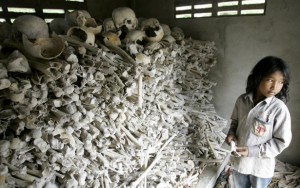
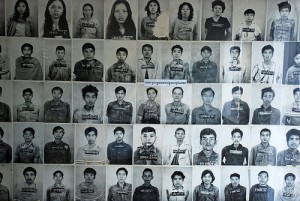
Steve made it to Thailand and met his future wife who had also escaped what are now known as “the killing fields”. Steve sold his treasured necklace for food and eventually struggled on to the United States. They were cold and hungry, but they were alive. As I sat open-mouthed and gripped by what I was hearing, Steve went on to describe himself in a way that I had only read about. He called himself a “17 April”. This was a designation and date the communists affixed to those they’d chased from Phnom Penh, under the pretext that there would be enemy bombing on April 17, 1975. Subsequently, one of the greatest genocides in human history would be recorded there. Steve recounted in horrific detail his experiences as his family struggled to survive famine, disease and the communist model of Pol Pot’s Khmer Rouge. Babies were smashed against rocks and trees, while whole families were summarily executed and buried as fertilizer for coconut groves. Millions would eventually die. There would be no more schools or infrastructure of a conventional sense, but rather a “system” by which all would be “equal” and loyal to one ideology, or else. Where have we heard this before? I interjected my thoughts where I could and we related our concern for the future of our children, a future reliant on recognizing and acknowledging evil such as this. But mostly, I just listened and absorbed. There before me was history in the flesh, spilling out the stories of the past and sounding the alarm without ever really knowing it.
The conversation eventually grew sparse. Steve explained that he rarely spoke of the past as it often induced nightmares so vivid and terrifying, that he would awaken and run from the house to confirm he stood on American soil. He seemed sad as he remembered his family and murmured of how we must all cherish and protect those we love. He explained how he has sent his wife and son to live in a liberated but still emerging new Cambodia for two years. He wants his boy to know of his father’s birthplace and heritage, and he wants him to truly understand and be grateful for his own birthplace, America. Ironically, Steve reaffirmed his desire never to return there himself. It is too painful for him.
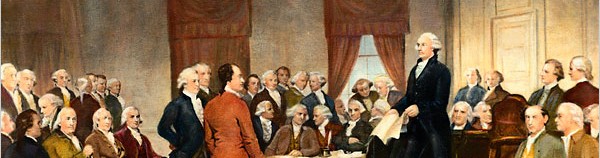
 I had one more thing to say to Steve, albeit with a very noticeable lump in my throat at that point, and that was “thank you”. I simply didn’t want to miss the opportunity to let him know how much the conversation had meant to me, though I think he was in another place as he walked off into the night. People ask me about my Constitutional passion, and about the reasons I’m so dedicated to the cause and history of this great nation. I tell them it is not sanctimonious or self-righteous, but rather just concern that drives my approach to the debates of our day. Concern that the next chapter in our history is unfolding right before our very eyes, and only “We the People” have the power to ensure it is a legacy our children will be proud of. I’m not suggesting all must or will be perfect, but to ignore lessons like these is to be simply or even intentionally ignorant. To let pride, vanity, or dogged ideology stand in the way of doing right by our kids, especially when we know the consequences of apathy and complacency, is just plain selfishness. In this authors humble opinion, we should be embracing the “Steve’s” of this world and begging them to speak of their experiences in our children’s classrooms. Only in this model can we be thought of as having done our part on behalf of the next generation. In the end, what could be more important.